|
I had come to Washington to meet with two members of
the Warren Commission, Gerald Ford, a Republican, who
was the House minority leader, and John Sherman Cooper,
a Republican, and the senior senator from Kentucky.
But first, at the suggestion of Rankin, I had lunch
with Dr. Alfred Goldberg, a Defense Department historian,
who had helped write the “Warren Report.”
He also, according to Rankin, had worked for the CIA.
Goldberg insisted on meeting me at noon at the All-State
Cafeteria. He was a tall, thin man with horn-rimmed
glasses and a hawk-like nose. We had a quick hamburger
at an outside picnic table, and then he suggested we
take a drive. As we drove in slow circles around Washington
in his Ford station wagon, he spoke in a quiet voice,
almost a whisper at times, about his role as a “historian”
on the commission. He was the only non-lawyer on the
staff. He was also the only person with an intelligence
background (except for former CIA Director Allan Dulles,
who had suggested Goldberg to Rankin.)
Goldberg said that the staff lacked “perspective
on the national security dimension.” When I asked
how that deficiency impinged on the investigation, he
looked at me sharply and said, “You are treading
on very sensitive ground here. Not a word of this can
be mentioned in your thesis, because there are issues
that cannot be made public.” I asked whether the
FBI, which did the initial investigation, was aware
of these issues. He did not reply, and, a few minutes
later dropped me back at the All-State Cafeteria. I
proceeded on to the Capitol.
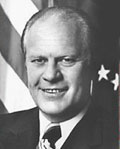
Congressman Ford was the first commissioner I was to
see. I arrived at Room 230, the House minority leader’s
spacious suite of offices in the Sam Rayburn Building,
promptly at 3:45 PM. Ford greeted me personally, pumping
my hand with the powerful grip of an ex-football star.
He was taller than I expected, with somewhat unruly
patches of flaming red hair. He directed me to a chair
next to his desk. Conspicuously displayed on it was
a copy of an article by Andrew Hacker in the New York
Times Magazine. He had apparently done his homework
on my professor. He then turned on his office tape recorder
for “his office record.”
The interview lasted exactly one hour. I asked the questions,
Ford gave the answers.
Q. What role did the Commission play in selecting its
staff?
A. We agreed on J. Lee Rankin--as it turns out a good
choice--then Rankin submitted staff and biographies,
and we approved. We, more or less, took his word. I
didn't know any one of them. We approved purely on Rankin's
say-so.
Q. Did the commission act as a sort of board of directors?
A. I didn't. I had my own independent investigation.
I had [Gerald] Stiles, and Ex-Congressman Ray, and a
Harvard lawyer, Frank Fallon, on my payroll, and they
evaluated testimony.
Q. There names are not listed in the Commission’s
administrative file.
A. You have the files? I kept these people from the
commission because I wanted to be sure they were independently
there.
Q. Was there disagreement on the bullet that hit Governor
Connally?
A. There was a wide spectrum of opinion among the Commission.
I was closest to the staff position that Connally was
hit by the same bullet that hit Kennedy. Senator Russell
was at the opposite extreme. He believed that Connally
was hit by a separate bullet. The other members ranged
in between us.
Q. Were there other areas of disagreement?
A. Yes. I can note two. The first draft of the report
categorically stated there was “no conspiracy.”
But after objections it was changed to, “No evidence
was found.” And in the chapter on Oswald's motivation,
I added “Marxism.”
Q. How was it determined when to wind up?
A. The deadline was September 28, 1964, because we wanted
to finish the report before the November election. Otherwise,
it might become an issue.
When I asked him about the division of responsibility
in the investigation, and showed him the chart that
J. Lee Rankin had given me, he looked flustered, and
then asked a staff aid to turn off the recorder. “I
left all the nitty-gritty to Rankin. He was Warren’s
man, and I had the Republican side of Congress to run.”
Ending the interview, he said, “By all means,
write your thesis. I'm writing a book on the subject.”
|